

Most horsemanship/riding lessons for ages 9-adult / beginner-intermediate skill levels are private 1:1 unless specific individuals agree to work with other students for the social experience.
Lessons are taught by instructor & farm owner, Kaye Handlon.
Fees
Private Lessons w/ Riding
- Lessons for ages 10-13 at our facility using our school horses, 1 hour / $50
- Lessons for ages 14+ at our facility using our school horses, 1 hour 30 minutes / $70
- Lessons at our facility using the student’s horse, 1 hour / $45
Supplemental Intensive Lungeline Session – Seat & Balance Development
Students must be skilled enough to get the horse, tack up, and be ready on their own. This will be a highly focused, skills-drill style session for practicing existing skills, not a lesson on learning new material.
-
- Lessons at our facility using our school horses, 30 minutes riding / $25
Non-Riding Topics
- See our new *Horsemanship / Non-Riding group program for adults!
Student Requirements
Students will need an equestrian helmet and proper riding shoes.
For the first three lessons, we will allow good-fitting bicycle helmets, and fully foot-covering athletic shoes / sneakers.
After the first three lessons, students need to purchase an ASTM SEI certified helmet for equestrian use, and shoes that are appropriate for riding, including equestrian hybrid sneakers or equestrian hybrid work shoes that are specifically for riding, for example Ariat Terrains, or paddock boots. Tall English boots are not necessary, and cowboy boots often slip down a rider’s ankles when we are doing exercises without stirrups.
Pants that are comfortable and giving with a little bit of stretch are necessary. Some riders find the thick inseam on jeans to be uncomfortable.
Eventually, riders may also want to purchase a pair of half chaps. If you have already purchased riding sneakers, you may need to purchase synthetic mesh half chaps with an elastic panel so they fit around the ankles of those boots.
What is Taught / Styles & Philosophies
Horsemanship 101

These are the skills needed to handle a horse for daily routines, in a style that promotes good horse-human relations, safety, and sanity for all.
- Ground handling / ground work for daily care activities.
- Grooming.
- Basic body work (for relationship building and equine body health).
- Tack & equipment use (daily handling gear, riding equipment).
- Basic first aid.
- Basic feeding.
- Anatomy & conformation.
- Ethology / hippology – what a horse truly is as a species.
- Teaching through an ‘experiment’ mindset, encouraging the student to become an independent self-thinking horseman.
- Self improvement / personal development theories are also discussed as it is applied to human learning, such as “Process before you proceed” and “Think, Act, Check, Then Change”.
Riding

- A general purpose / utilitarian balanced riding position for work in the arena, over small obstacles and out in the open on varied terrain.
- Use of the aids (cues / signals) “form & function” / “effective & efficient” principles, biomechanics, and relationship building / preserving.
- We use balanced general purpose english saddles because they allow the rider to do seating exercises without being restricted by the bars and horn of a western saddle. Also, compared to a western saddle, english saddles are generally easier to fit to the horses, as the stuffing in the saddle can be frequently adjusted to the horse’s changing musculature by a saddle fitter. Despite using general purpose english saddles we are not ‘discipline bias’. We work on developing a functionally fit horse & rider for many activities.
Seating Exercises on the Lunge Line

- Frequent work on the lunge line gives the rider the ability to develop balance, strength, suppleness, and a sense of feel without having to use brain & nervous system resources to control the horse.
- Teaching with a discovery mindset, using a lot of “1 millimeter adjustments”, looking for 1% improvements, and asking “What if you tried it like this?” will encourage students to truly feel what is and is not working.
Work – In – Hand
- Deeper work that focuses on the horse’s responsiveness to our intentions.
- Working from the ground allows the rider to see the horse’s physical balance and mental state.
- Advanced ground-work allows the horse to improve their fitness without the added weight of the rider.
Liberty Work
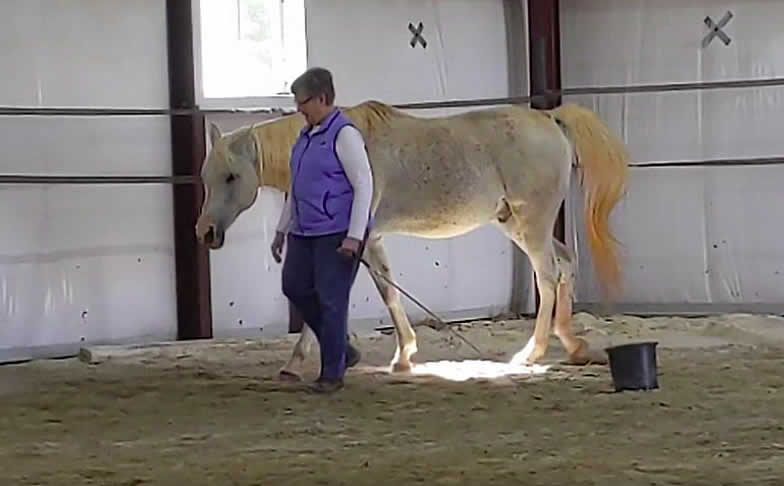
- How to be with a horse, as a companion, in his / her environment without expectations of the horse performing for ‘us’.
- How to go beyond being merely tolerated by the horse, learning how to develop a blending with a horse similar to a school of fish or a flock of birds.
- Learning how to ask the horse to do things without equipment will help the student develop more sensitivity while using equipment.
When-
Lessons are scheduled based on the instructor’s and student’s schedules, one lesson at a time (no packages). Typically, there are no lessons on Sundays, and lessons don’t start before 8:00 AM or after 6:30 PM.
What Else-
We have a small, fully insulated and enclosed riding arena for year-round use. We only cancel lessons due to extreme weather / weather warnings.
Are you still curious about what methods and other professionals we follow? Visit the farm’s Starting Point Equestrian Facebook Page for our posts and to see who we admire & follow.